Chloe Jenssen
The Woman in Cabin 10Chloe Jenssen, known professionally as Wylde, is a former model and the wife of financier Lars Jenssen. On the Aurora Borealis, she belongs to the wealthy passenger group gathered around Richard Bullmer, yet she is more perceptive and less ceremonially polished than the setting initially suggests. Her striking appearance, familiarity with cosmetic concealment, blunt remarks about abusive relationships, and later concern for Laura Blacklock make her an important figure in the novel’s treatment of appearance, credibility, and the unstable boundary between performance and recognition.
Identity and Social Position
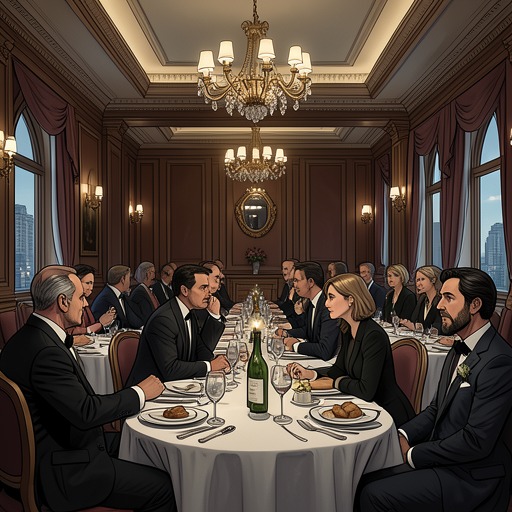
Chloe first appears as a white-blonde former model whose beauty gives her an almost unreal quality. Ben Howard identifies her as Chloe Jenssen and explains that her professional name is Wylde; she is married to Lars Jenssen, a powerful figure in finance whom Richard Bullmer may be cultivating as a potential investor. Chloe is therefore connected to the economic world that makes the cruise possible, but her public identity is also explicitly professional and constructed. The name Wylde belongs to the fashion industry, while Mrs Jenssen belongs to marriage and elite society, and the two identities coexist without fully becoming the same thing.
Her appearance is described through the visual language of modeling: prominent cheekbones, slightly Slavic eyes, and white-blond hair. The story of her discovery by a modeling scout in an out-of-town supermarket heightens the contrast between an ordinary setting and the spectacular persona that followed. At dinner, however, Chloe’s glamour does not make her remote. Her low, husky voice carries a hint of an Essex accent, and her powerful handshake, heavy rings, and irreverent humor complicate the immaculate image presented by her dress and face.
Chloe also occupies a privileged position within a sharply divided shipboard society. Laura Blacklock is struck by the contrast between the airy passenger spaces and the cramped, windowless crew quarters, an arrangement that makes the Aurora Borealis a visible version of an upstairs-downstairs world. Chloe belongs securely upstairs, among the people who can treat an eight-thousand-pound voyage as an expensive indulgence rather than an unimaginable luxury. Yet she is not presented as a simple representative of that class. She notices vulnerability, recognizes the signs of violence, and occasionally speaks with a directness that punctures the manners surrounding her.
Encounters with Laura Blacklock
Chloe introduces herself to Laura at dinner, using both her married name and her professional identity. She jokes about Laura’s name sounding like that of a 1950s film star, and the exchange briefly creates an ease that the formal dinner otherwise lacks. Chloe’s warmth is not entirely gentle—her language is coarse and her humor can be startling—but it is socially active rather than merely decorative. She draws Laura into conversation while Lars Jenssen remains occupied elsewhere, rolling her eyes when he fails to join the introduction.
Her attention becomes more significant when she asks about the bruise on Laura’s cheek. Chloe immediately recognizes that the question may be intrusive and tries to withdraw it, explaining that she has been in bad relationships herself. The remark does not establish a complete history, but it gives her response a personal basis: she reads the mark not as an unfortunate flaw to be hidden from polite company, but as a possible sign of harm. Later, after Archer Fenland demonstrates a self-defense maneuver with an unsettling lack of care, Chloe tells Laura to ignore him and offers her practical assistance. She says that Laura can visit her cabin for something to cover the bruise, because Chloe has an extensive collection of cosmetics and is a very capable makeup artist.
This offer makes makeup more than a luxury or professional skill. For Chloe, cosmetics can manage the visible evidence of violence, allowing Laura to navigate a social environment in which bodily signs are scrutinized but uncomfortable truths are avoided. The offer is therefore double-edged: it provides immediate protection, yet it also participates in the wider culture of concealment aboard the ship. Chloe does not ask Laura to deny what happened, but she understands that survival may require controlling what others are permitted to see.
Beauty, Makeup, and Performance
Chloe’s appearance changes dramatically when she removes her makeup in the spa. Laura is surprised that the unmade-up Chloe looks almost like a different person: the smoky eyes and pronounced cheekbones that had seemed so powerful appear faded and flat in daylight. Chloe catches Laura looking at her reflection and explains that she has removed the makeup for a facial, adding that she has already described herself as a skilled makeup artist.
The scene exposes the labor beneath the apparently effortless model image. Chloe’s beauty is not represented as wholly false, but it is shown to depend on techniques, products, lighting, and deliberate presentation. The same woman can appear otherworldly at dinner and strangely diminished in the spa, not because either version is the complete truth, but because each is a successful arrangement of visible signs. Her professional expertise gives her an unusual understanding of how identity can be made persuasive through surface.
That expertise also prepares the novel’s larger revelation about Anne Bullmer. When Laura finally recognizes the woman in the Pink Floyd T-shirt as Anne, she understands how hair and penciled eyebrows have transformed the face. Without them, Anne appeared gaunt, ill, and prematurely aged; with dark hair and carefully shaped brows, she looked young, healthy, and alive. Richard Bullmer’s prohibition against photographing Anne becomes newly intelligible because fixed images might have exposed the deception. Chloe is not responsible for that central impersonation, but her presence as a model and makeup artist places her within the novel’s sustained concern with cosmetic performance, identity management, and the fragility of visual evidence.
The Mystery and the Passenger Alibis
Chloe becomes relevant to Laura’s attempt to reconstruct the night of the suspected murder. Ben says that he was in the Jenssens’ suite, where Chloe was present, and insists that no one could have left without passing through the only door. He recalls that Chloe read for a while before going into the adjoining bedroom, which had no exit except through the main room. On this account, Chloe and the other people in the suite can be excluded from the group of possible killers, at least for the period described.
Laura nevertheless tests the alibi directly. When she asks Chloe about the previous night, Chloe says that she was not playing poker but was present while the game took place. She laughs briefly at Lars’s losses, noting that he can afford them, and Cole Lederer responds to her with evident familiarity. Her answer supplies information without displaying any concern about the investigation, reinforcing the impression that she treats the ship’s social life as a game whose rules can be navigated through confidence and selective candor.
Her presence around the group is not entirely stable. At one dinner, Lars says that Chloe is ill and lying down in her room; on another occasion she appears with Lars, Richard, and Cole in the enormous upper-deck Jacuzzi, where they sit amid steam and roaring jets. These appearances keep her connected to the central social circle while also making her movements part of the uncertainty surrounding the cabin 10 incident. She is close enough to the men under suspicion to matter, but the available account of the Jenssens’ suite gives her a potentially exculpatory location during the critical hours.
Relations, Sympathy, and Ending Position
Chloe’s relationship with Laura remains limited, but it is more humane than many of the relationships Laura encounters aboard the ship. Chloe offers conversation when Laura feels socially outclassed, notices the injury that others might prefer not to mention, and proposes a concrete way to help. Her response does not eliminate the hierarchy between them—Chloe’s clothing, beauty, and professional confidence continually remind Laura that they inhabit different social worlds—but it creates a brief alliance across that distance.
Chloe’s relationship to Anne is much weaker. Chloe says that the spare place at the first table was probably intended for Anne, who decided to eat in her cabin because she was unwell, and admits that she does not know Anne well. This lack of prior familiarity becomes part of the impersonation plot’s plausibility: the passengers have not known Anne long enough to recognize a substitute with certainty, and Richard has ensured that there will be no useful photographs. Chloe’s social proximity to the Bullmers therefore coexists with personal distance from the woman whose identity is being performed.
The novel ultimately leaves Chloe alive and outside the central conspiracy. After Laura is rescued and returns to Britain, Chloe sends a message expressing hope that Laura is all right and offering help from herself or Lars. The message, relayed through Judah Lewis and marked by his phonetic spelling of Jenssen, extends Chloe’s earlier practical concern beyond the ship. It does not undo her membership in the privileged world that helped conceal the crime, but it confirms that her attention to Laura was not limited to the immediate theater of the cruise.
Narrative Significance
Chloe functions as a social intermediary and as a counterpoint to the more destructive uses of appearance in the plot. Her professional identity is built on transforming faces and controlling impressions, while the Bullmer conspiracy turns illness, hair, eyebrows, clothing, and the absence of photographs into instruments for replacing one woman with another. Chloe’s makeup knowledge therefore resonates with the novel’s central question of whether seeing is enough to know.
She also complicates the division between glamorous passengers and vulnerable women. Chloe enjoys the privileges of the Aurora Borealis, jokes about money, and moves easily through its elite spaces, yet she is alert to bruises, bad relationships, and the emotional strain beneath polished surfaces. Her kindness is not a grand act of rescue; it is a small, practical gesture offered in a setting that repeatedly rewards silence. That modesty is precisely what gives her narrative value. Chloe shows that recognition can begin with noticing what a room has agreed not to see, even when the person doing the noticing remains entangled in the room’s wealth, performances, and evasions.